Part 1
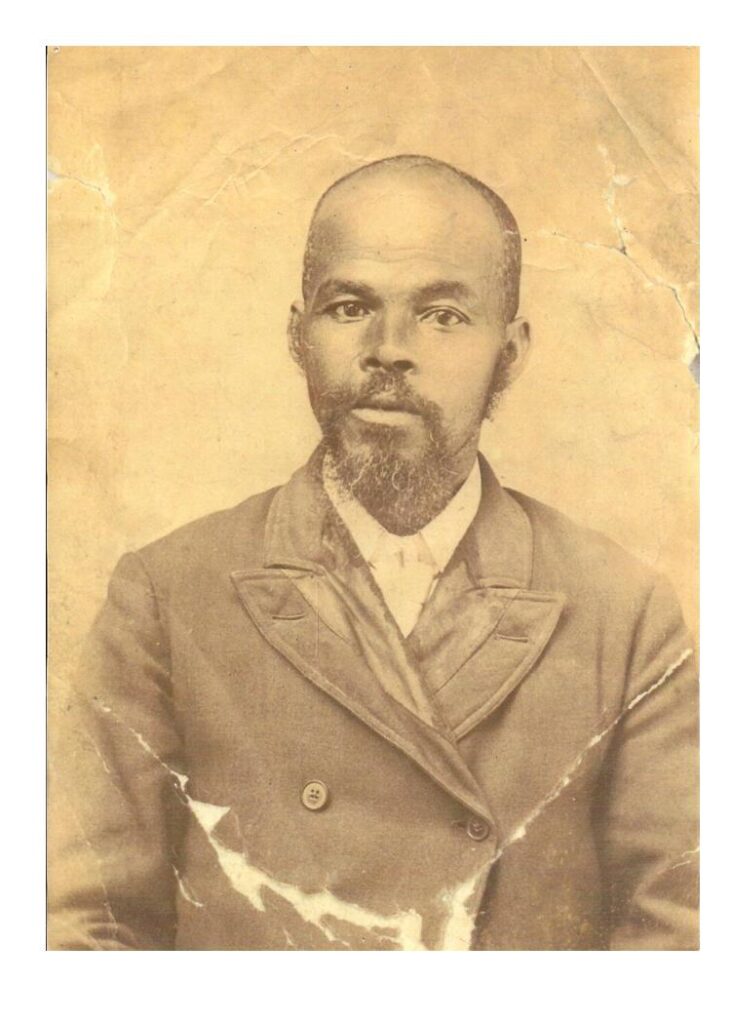
The Historic Rosedale Plantation was home to many enslaved individuals whose lives, skills, and stories are central to understanding the history of the site. Among them was Nat (Caldwell), known simply as “Nat,” an enslaved blacksmith whose legacy continues to resonate today.
We have yet to discover his date of birth or death; however, we have found that the fi rst known records of Nat appear in 1826, in the ledgers of Reverend Samuel Caldwell, pastor of Sugar Creek Presbyterian Church. At that time Reverend Caldwell enslaved approximately 23 individuals, Nat among them. In February 1827, following Reverend Caldwell’s death, David T. Caldwell, Samuel’s oldest son purchased Nat ($450), Alfred ($380), Ephraim ($200) and Mark along with a female named Nancy from his father through a court-mediated settlement of the estate. These three men may have even been brothers. They each were also a part of the household in which Nat was raised. Nat’s common-law wife (marriages of the enslaved were not legally recognized in North Carolina), Agnes and their children were left behind.
In February of 1832, fi ve years after purchasing Nat, Dr. Caldwell purchased Agnes and her three of her children, for $700.00. Later that same year, Dr. Caldwell purchased the Rosedale estate he had been renting. To the property he brought Agnes and her children – Little Nat (6), Manda (4), and Randall or Renolds (1). This purchase and relocation increased the enslaved community at Rosedale. Nat as well as many other enslaved individuals tried to lead a somewhat normal life even though they were bound by slavery.
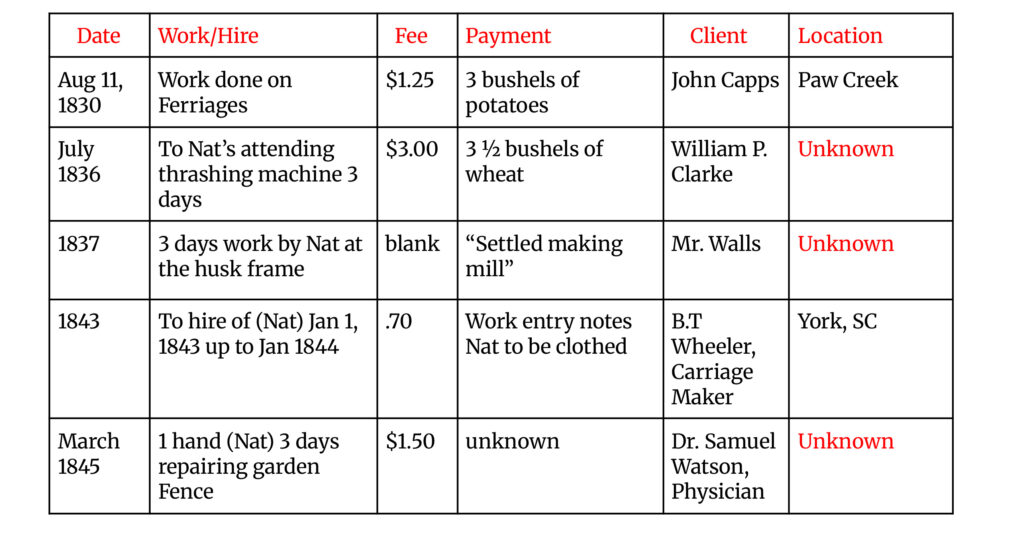
Nat was enslaved at Rosedale from 1827 until his death. He was approved as a member of Sugar Creek Presbyterian Church in 1835 along with an enslaved woman named Sarah, listed as Dr. Caldwell’s property. Although little is known about Nat’s early life, it is clear that he was a highly skilled artisan. As a blacksmith, carpenter, and mason Nat possessed specialized knowledge that was essential to the plantation’s daily operations. His labor would have included repairing tools, wagons, and forging household hardware, an invaluable contribution to the estate and surrounding community. He was also hired out anywhere from a day to a year to various people in the community for a great many things including, repairs on a ferry, repairing fences, farm equipment, and chimneys.
Blacksmithing required strength, intelligence and precision. Nat’s work would have placed him at the center of both plantation life and the broader economic network of antebellum Charlotte. Like many enslaved craftspeople, his talents were exploited for the benefit of his owner. Yet they remained a testament to the resilience and excellence of the enslaved craftsmen of the period.
Part 2
Nat’s life as an enslaved Blacksmith
Nat was one of several blacksmiths at Rosedale and was believed to be the first. We don’t know who trained him as records on the enslaved were limited. However, his skill as a blacksmith was so strong that he was often sent out for days, weeks or a year at a time to work outside of Rosedale. During the antebellum period, it was common for enslaved people to be hired out or used as labor in exchange for goods or store credit. By 1830, Nat was well recognized for his craftsmanship. Dr. Caldwell hired him out several times, including work on ferries and a threshing machine, (A piece of farm equipment that separates grain seed from the stalks and husks) over three days. Nat’s labor along with that of other enslaved blacksmiths was vital to Rosedale’s economy.
Although Rosedale was smaller than many Southern plantations it profited from cash crops like corn, wheat, oats and lumber grown on about 250 of its 911 acres. The plantation also relied heavily on Dr. Caldwell’s income as a physician and the earnings from the blacksmiths’ labor. While Caldwell earned around $1.25 to $2.00 per medical visit, blacksmiths’ like Ephraim could bring in $10 to as much as $20 a month, making enslaved blacksmiths among the top earners on many plantations.
Chronicle of His Work Life – Part 3
(Information from D.T Caldwell’s Plantation Journal)
The Enslaved Blacksmith
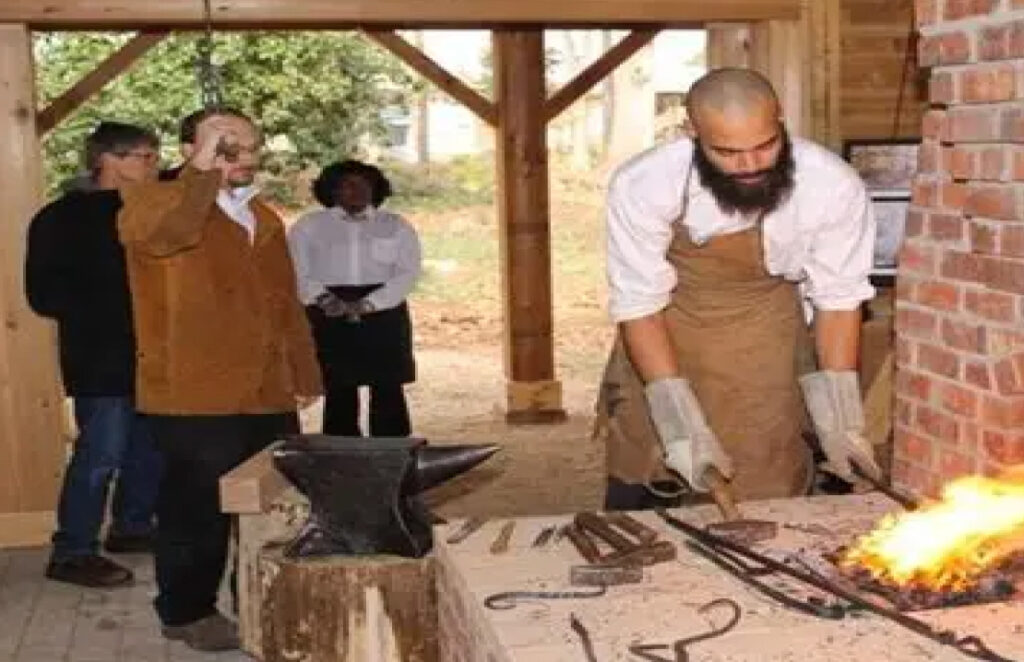
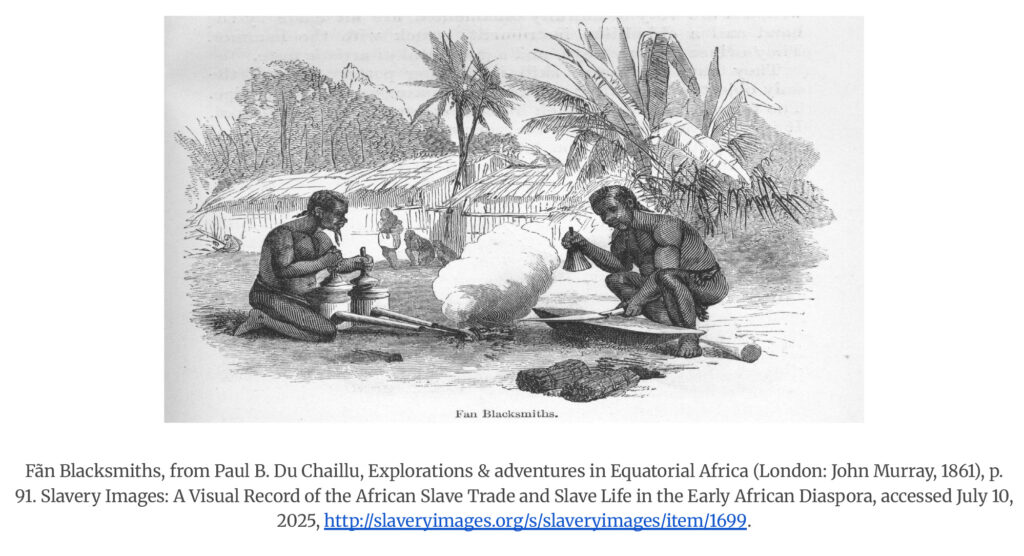
The blacksmith on an antebellum plantation was highly valued. Most of his days were spent repairing worn tools and maintaining essential equipment. These tasks were typically assigned to adult males due to the physical strength and skill required. Throughout the year, certain tools — such as plows, corn knives, and harrows — required regular sharpening. Before the rise of the plantation economy, enslaved blacksmiths and craftsmen were highly valued during the colonial period for their critical skills. In many West African societies blacksmiths held positions of great respect and infl uence, both socially and spiritually. Their ability to transform raw iron into tools, weapons and ritual objects was often seen as a divine gift. They were revered as keepers of sacred knowledge and tradition. This reverence carried over into the Americas.
At Rosedale, Nat though enslaved, was deeply respected for his craftsmanship. The smiths at Rosedale were so highly regarded that Alphred was rented out to H. C. Owens to rebuild the U. S. Mint. It is believed that Nat Jr. and Randall learned blacksmithing at the feet of their father.
Sources
- Mount Vernon Ladies’ Association. “Blacksmith Shop.” George Washington’s Mount Vernon. Mount Vernon, VA. Accessed July 23, 2025.https://www.mountvernon.org/the-estate-gardens/location/blacksmith-shop
- Bishir, Catherine W. Crafting Lives: African American Artisans in New Bern, North Carolina, 1770–1900. Chapel Hill: University of North Carolina Press, 2013.
- Mecklenburg County Register of Deeds. Historical Real Estate Records. Book 22, pages 308–309.
- Caldwell, David T. Plantation Accounts of Dr. D. T. Caldwell. Vol. 2, p. 6B. Special Collections, J. Murrey Atkins Library, University of North Carolina at Charlotte.
- George Washington’s Mount Vernon. “Skilled Trades.” George Washington’s Mount Vernon. Accessed July 23, 2025. https://www.mountvernon.org/george-washington/slavery/skilled-trades
- Sugar Creek Presbyterian Church (Charlotte, N.C.). Session Records. Sugar Creek Presbyterian Church Archives, Charlotte, North Carolina.
- Du Chaillu, Paul B. Explorations & Adventures in Equatorial Africa. London: John Murray, 1861. Quoted in Slavery Images: A Visual Record of the African Slave Trade and Slave Life in the Early African Diaspora. Accessed July 10, 2025. http://slaveryimages.org/s/slaveryimages/item/1699.
- Lehman, John. Photograph of Gilbert Walker, Blacksmith. Slave Dwelling Project. Accessed July 23, 2025. https://slavedwellingproject.org.
Written by: Eric Hairston
Edited by: Margarette Joyner, Kyle Smith, Barbara Jackson, Martin Foil
Introduction
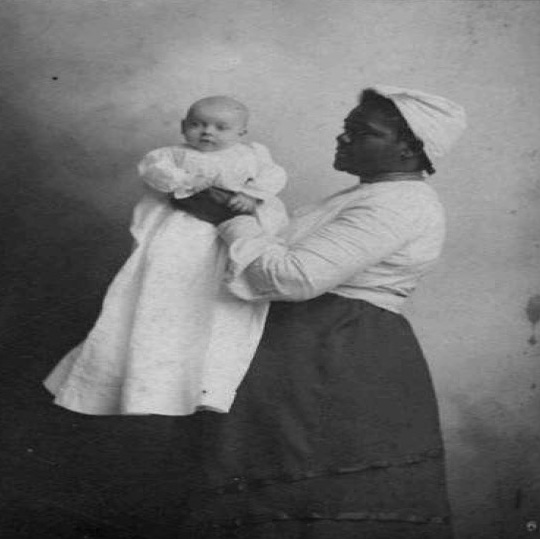
Over the course of Historic Rosedale’s existence, before emancipation, some forty enslaved individuals labored on the land and provided financial prosperity to the Frew, Davidson, and Caldwell families. Little is known about the lives and perspectives of these forty individuals, aside from their names, due to a lack of recorded information. The African American Legacy Project was created to provide a narrative regarding these enslaved persons in a truthful and equitable way. We have chosen “Cherry” as our first effort in fulfilling this mission.
Origins
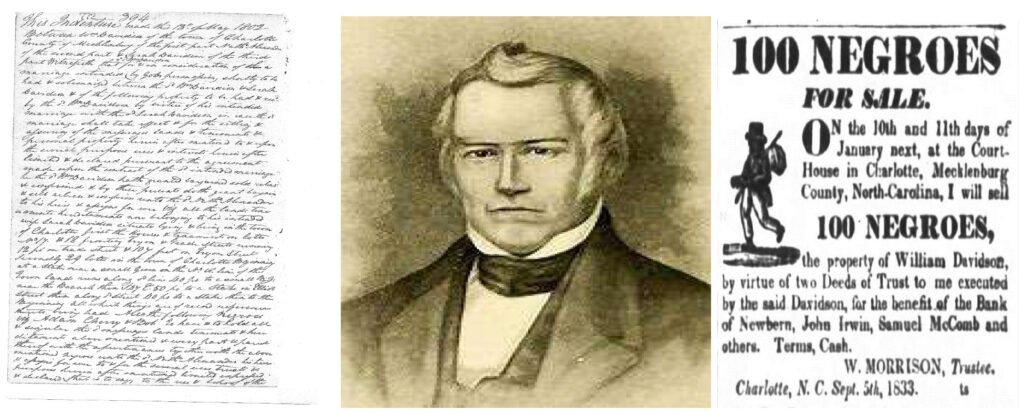
From journal entries we believe Cherry was a nursemaid, who was first owned by Thomas Davidson. Thomas Davidson was born in 1755 and was a merchant in Mecklenburg County. He was married to Sarah Frew, sister of Archibald Frew, the original builder and owner of Historic Rosedale. Davidson passed away on July 24, 1800 and in his Will and Testament he would leave his wife, Sarah, various assets and property. His Last Will and Testament is the earliest known document to mention Cherry. He writes, “First I give and bequeath to Sarah, my beloved wife, one Mollatta girl named Cherry, one horse and saddle and…”

As illustrated in this document, enslaved people were considered property, inheritable property priced on inventory lists, alongside a “horse and saddle.” Cherry was also listed as a girl, but that does not indicate her true age. Based on information gathered from records and oral histories, we can interpret that she was young, probably twelve or younger. She is also described as being “Mollatta,” which is a gender derivative of the word Mulatto. This was and still is a racial category that refers to someone of mixed racial background, specifically those of African and European descent. Based on her classification she would have had fair to lighter brown skin and therefore considered, by some, a better class of Negro. Mixed-race enslaved persons were common due to the sexual improprieties Black women faced from their owners as well as other White men. Mulatto women were often charged with domestic work, keeping them inside the house for various reasons. One known reason being that the child was the daughter of the owner and the master sometimes developed a fondness for the children they fathered. Another reason is because they were considered pleasing to the eye. Regardless of the reason, it was not uncommon for them to face harsh punishments from the mistresses of the house due to jealousy. According to slave narratives, they could also face isolation because of the divide created between skin tone indicating those with lighter skin were better than those with darker skin. During Jim Crow this idea was further enforced by “the brown paper bag test.” You were considered beautiful if you were lighter than a brown paper bag. This left the mulatto not belonging to any group because they were shunned by some Black people as being too good and shunned by some White people as not being good enough.
Although information regarding Cherry’s early life is limited, we have been able to create an account of her adult life through primary sources such as Thomas Davidson’s Will, and through secondary sources such as slave narratives and stories that have been passed down through generations of both the Black and White families of Rosedale.
The Grove
After Thomas Davidson died in 1800, Sarah Frew Davidson, two years later, married William Davidson the Executor of Thomas’s Last Will and Testament and her nephew by marriage. William served as a State Senator in the U.S. House of Representatives and was one of the largest slaveholders in Mecklenburg County, owning upwards of 100 enslaved people.
As was the case with most marriages during that period, any property that a woman owned when entering a marriage would automatically be assumed by her husband. Sarah, however, ensured that her property, a house and storehouse located on Trade Street in the center of Charlotte, would remain hers after her marriage to William through the drafting of a legally binding contract which was signed by her and her second husband, William Davidson. The document referenced all of her property which included: “the following negroes, Adam, Cherry, and Bob to have and to hold…”

From the signing of this document, Cherry and all of her future children would forever be the legal property of Sarah Frew Davidson and her family. After Sarah’s marriage, Cherry lived on William Davidson’s Plantation called The Grove which was one of the largest in North Mecklenburg County.
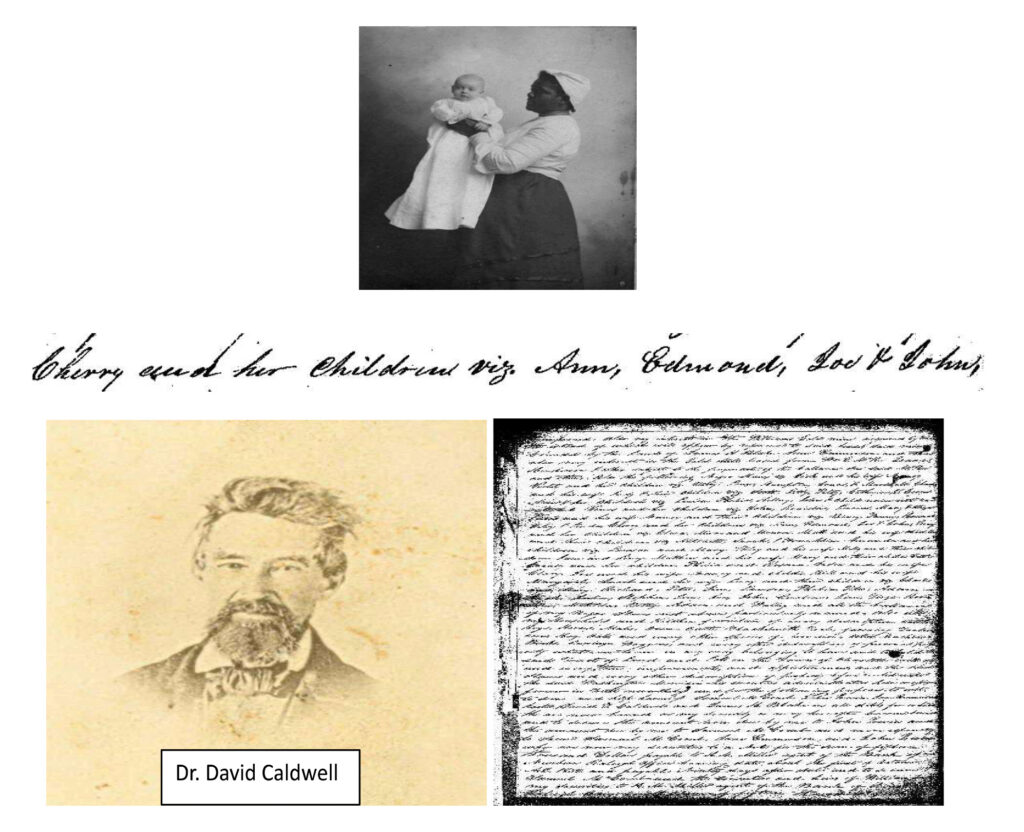
Cherry’s role was the children’s caretaker. While still at The Grove, Cherry was not only tasked with taking care of the Davidson children, she was also raising her own. In William Davidson’s Deed of Trust in 1833, he took inventory of all the property he owned, which included his enslaved. This document provides evidence of Cherry’s known children at the time: “Cherry and her children viz. Ann, Edmond, Joe and John.” In 1800 when Thomas Davidson referred to Cherry as “a young molatta girl” in his Last Will and Testament this could potentially put Cherry in the age bracket of approximately twelve years of age or younger. By 1804, at a guesstimate age of 16, Cherry may have had her first child. Women on the average in the 19th century gave birth every two years. If her first child was born in 1804 then consecutive children may have followed Ann (1804), Edmond (1806), Joe (1808), and John (1810). Though the dates are hypothetical there is a possibility that Cherry was having children at the same time as Sarah Davidson; Margaret (1803), Sarah (1804), Harriet (1806) and William (1810). If indeed Cherry was in the stage of breastfeeding her children she more than likely was required to nurse the Davidson’s White children. Because some mistresses held the belief that breastfeeding was beneath them and unfashionable for their social status, that task was passed off to an enslaved woman. These enslaved women, or wet nurses, would have had to neglect their own children while providing care for the white family’s children.
Enslaved women were not only profitable to their owners based on the labor they provided, but also on how many children they could produce, ultimately increasing the owner’s workforce. By law any child born to an enslaved woman was considered enslaved as well.
When it came to the health of his enslaved, William Davidson would pay his son-in-law, daughter Harriet’s husband Dr. David Caldwell who lived at Rosedale, to visit The Grove. Dr. Caldwell would meticulously record his transactions and movements when it came to seeing patients within Mecklenburg County. From his plantation accounts, we know that on February 10 and April 9 of 1833, W. Davidson paid Dr. Caldwell $2 and $2.25 respectively to “Visit Cherry. Specifics of what Cherry’s ailment was is unclear. However we can surmise that if Dr. Caldwell was paid to treat her, it was serious. If ailments were not considered life threatening the enslaved were taken care of by the elders of the community who possessed great medicinal skills using concoctions of water, wine, herbs, roots and vegetables. Records indicate that on April 9th Cherry was given a cathartic, a substance that would “purge” the contents of her body, which at the time was administered for various reasons, such as melancholy, depression, irregular menstrual cycles, fever or a cold.
Rosedale
Based on Caldwell family lore, as Harriet Davidson Caldwell lay dying from Erysipelas, a form of strep throat, she asked her father, William Davidson, to send for Cherry from The Grove. This would be the same Cherry who helped raise Harriet and would now help raise Harriet’s children. Research has yet to uncover what became of Cherry’s four children as they would have been adults at that time. We also don’t know who she had children with, if he was someone from The Grove or a neighboring plantation. We do know however, according to the advertisement shown above, due to financial struggles, one hundred of William Davidson’s enslaved persons were sold on January 10 & 11 of 1833, a month or two before Cherry’s medical treatment. This would have been devastating to all enslaved individuals not knowing where their family and friends ended up.
In 1845, Cherry, at the approximate age of 57, came to Rosedale to work in her third household of white families. She was once again separated from the people she knew and her children that may have been sold and lost to her. Cherry was tasked to tend and care for the younger Caldwell children who still remained at home, Sarah Jane (12), Robert Baxter (7), and Alice (1). She mainly cared for the girls and slept in their room on a pallet on the floor. A pallet was basically an oversized pillow filled with straw or old rags. According to oral accounts from both Black and White descendants, when the Caldwell girls would go to sleep, Cherry would smoke her pipe. Dr. Caldwell had a very strict ‘no smoking’ rule in the house. However, she would defy this rule by blowing the smoke up the chimney in the girl’s room. It is said that the daughters knew about Cherry’s pipe smoking, but never told their father due to the fondness they had for her and the enjoyment of their father’s obliviousness. Cherry’s smoking in the girl’s bedroom is an example of an act of resistance. Acts of resistance were done by enslaved individuals as a form of maintaining their humanity, providing a hint of freedom and control of something in their lives.
Legacy
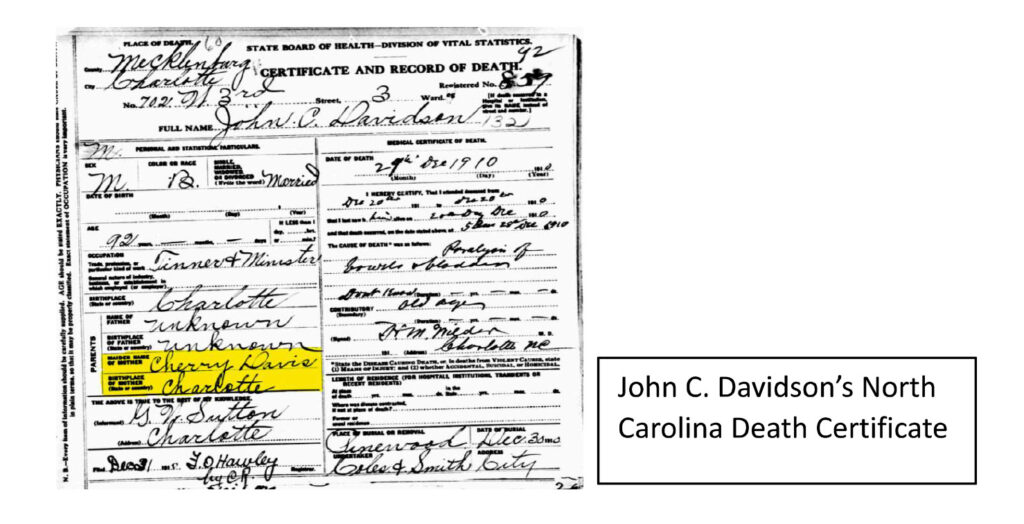
We know that Cherry remained at Rosedale for a few years after Harriet Davidson Caldwell died. Dr. Caldwell remarried in 1849 to Adeline Hutchinson and together they had a child. Adeline brought to the marriage some of her enslaved people: Andy, Rachel and children, and Caroline. One of these women were most likely domestic workers where that may have taken the place of Cherry as the nursemaid. Through speculation it is believed Cherry returned to William Davidson’s or may have passed away. It is at this juncture that we lose Cherry’s whereabouts. In the 1850 Slave Schedules for Dr. Caldwell and William Davidson there are no females listed in their 50s or late 40s, a possible indication that she died. Through genealogical research, there is evidence to indicate that her lineage may have continued. A North Carolina death certificate was recently discovered for a Black man named John C. Davidson, born in 1818 and died December 29, 1910 in Charlotte. Davidson’s occupation was listed as a Tinner and a Minister. It’s intriguing that his mother was listed as Cherry Davis who was born in Charlotte as well. While there is no definite proof that this is the son of Cherry Davidson, it is a step in the right direction for further research on her and her descendants.
Cherry’s story is only one of at least forty enslaved individuals that we know of who lived and labored on Rosedale property. Through continuous research, we seek to understand more about her and the other enslaved people whose stories are necessary in telling the whole truth of Historic Rosedale.
Written by: John Cooper
Edited by: Margarette Joyner & Elizabeth Myers